Freedom 250 Grand Prix track: the 7-turn National Mall circuit, explained
On 23 August 2026, IndyCars will race down Pennsylvania Avenue with the Washington Monument on one side and the Capitol dome filling the mirrors. The Freedom 250 Grand Prix of Washington, D.C. is the first auto race ever held on the streets of the nation's capital, and by any measure of spectacle it has already won. The interesting question is narrower and harder: is the track any good?
Because the number that jumps out of the spec sheet is seven. Seven turns, over 1.7 miles. That is the loosest street circuit IndyCar has raced on in years, and it puts the Freedom 250 in unusual company — closer in character to a temporary superspeedway than to St. Petersburg or Long Beach. This article breaks down the full track details, walks the lap corner by corner, and works through what seven turns actually means for the racing. And because reading about a layout is never the same as driving one, you can open the circuit in the designer and change it yourself.
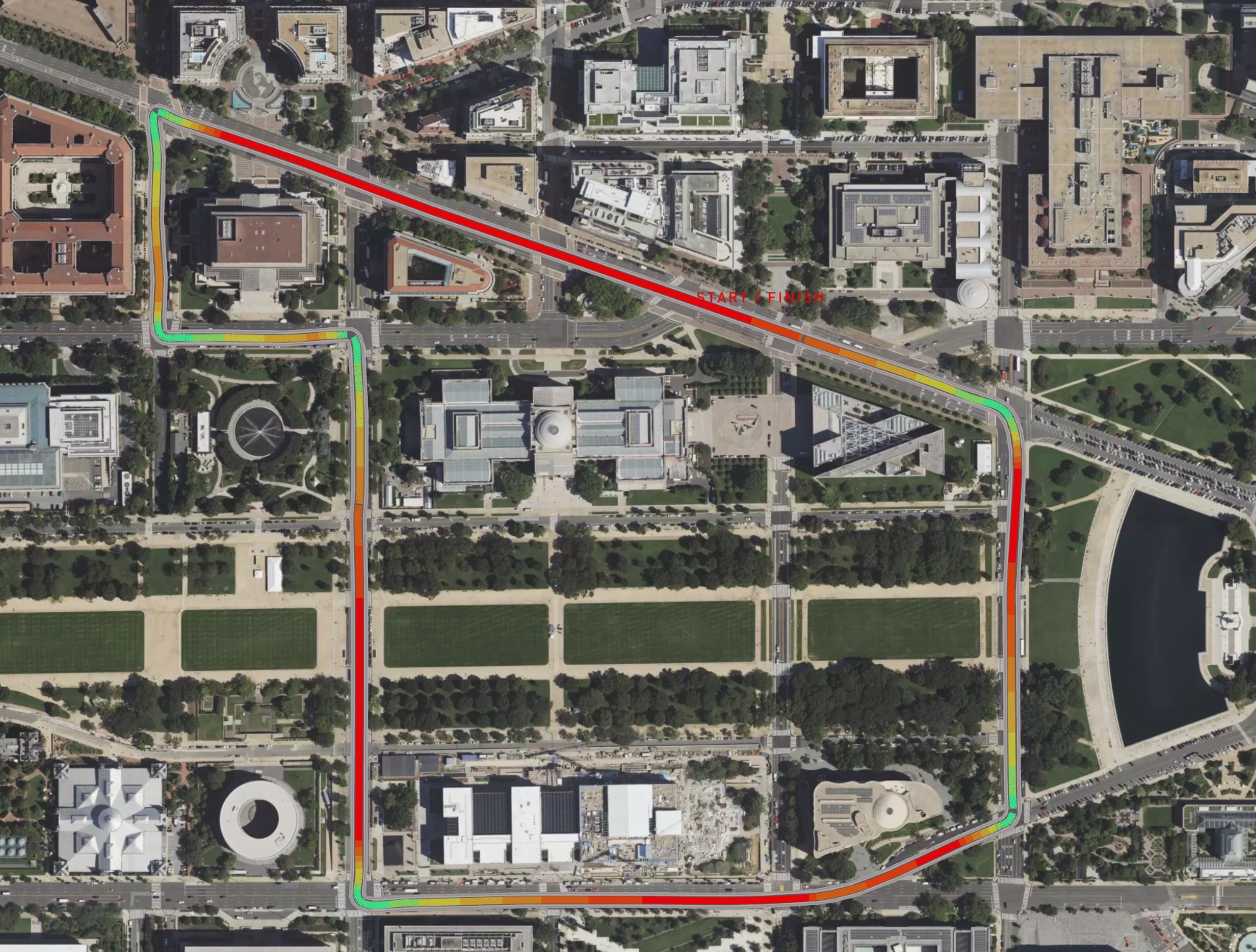
Freedom 250 Grand Prix track details
The headline numbers, as published by IndyCar: the circuit is 1.7 miles (about 2.7 km) with seven turns, and the race runs to 125 laps — roughly 212 miles. Early releases quoted 1.66 miles, and both figures still circulate; the gap is the kind of rounding difference that comes from where a measured centreline sits through the corners, and it matters to nobody except people who build track models for a living. Lap times are expected in the 53 to 55 second range, with cars topping 180 mph on the main straight. That works out to an average lap speed around 113 mph, which is fast for a street circuit.
The defining feature is the 0.4-mile sweep along Pennsylvania Avenue, framed by the Washington Monument at one end and the Capitol at the other. Pit lane sits alongside it, between Turns 1 and 2. The start-finish line is on 3rd Street in front of the Capitol, and the lap takes in the National Archives, the National Gallery of Art and the Smithsonian National Air and Space Museum on the way round.
The event itself was created by executive order in January 2026 to mark the United States Semiquincentennial, which explains the name: the 250 is the anniversary, not the race distance. It sits as Round 15 of 18 on the 2026 NTT IndyCar Series calendar, between Markham and the Milwaukee Mile doubleheader, with an IROC support race on the Saturday and free general admission for the fans on the Mall.
A lap of the Freedom 250 circuit, turn by turn
Trace the published route onto the Washington street grid and the geometry becomes concrete. Here is the lap as the drivers will take it, running anticlockwise.
Start — 3rd Street NW. The grid forms up on 3rd Street with the Capitol behind, and there is roughly 345 metres of run to the first braking point. That is a short launch to Turn 1 by IndyCar standards, and it makes the opening lap genuinely dangerous: the field will still be sorting itself when it arrives.
Turn 1 — onto Pennsylvania Avenue. A left of about 70 degrees that opens the lap out onto the main straight, with pit entry immediately after. This is a corner defined by exit rather than entry — get it wrong and you are a passenger for the next 700 metres.
The Pennsylvania Avenue straight. Roughly 740 metres from the exit of Turn 1 to the braking point for Turn 2 — organisers quote the avenue itself at 0.4 miles — all of it full throttle on a wide ceremonial boulevard, with the monuments doing the framing. It is the longest section of the track by a distance and the single most important piece of the lap.
Turn 2 — Pennsylvania at 9th Street. The heaviest braking zone on the circuit: over 180 mph down to a left-hander of roughly 110 degrees, with the National Archives sitting inside the corner. If there is a pass on this track, it happens here.
Turns 3 and 4 — the 9th Street complex. This is the technical heart, and it comes in quick succession: a 195-metre squirt down 9th Street from Turn 2, a 90-degree left onto Constitution Avenue, then 150 metres before a 90-degree right onto 7th Street. Note the direction — Turn 4 is the only right-hand corner on the entire circuit. Six lefts and one right is an asymmetry closer to an oval than a road course, and it has real consequences for tyre wear and setup.
7th Street, across the Mall. About 500 metres running south between the Hirshhorn and the museums, straight across the middle of the National Mall. The second-longest flat-out section of the lap.
Turn 5 — onto Independence Avenue. A 90-degree left at the end of a long approach. Not as violent a braking zone as Turn 2, but the second real overtaking chance, and the one that produces the opportunist late lunge.
Turn 6 and Turn 7 — Independence, Maryland Avenue, and home. Independence Avenue runs about 360 metres east past the Air and Space Museum before bending left through roughly 35 degrees onto the Maryland Avenue diagonal — an arc rather than a corner at IndyCar speeds, more a lift than a brake. Another 240 metres, then a 55-degree left onto 3rd Street and back to the line. In practice Turns 5 through 7 form one continuous 600-metre curved rush with a single interruption in it.
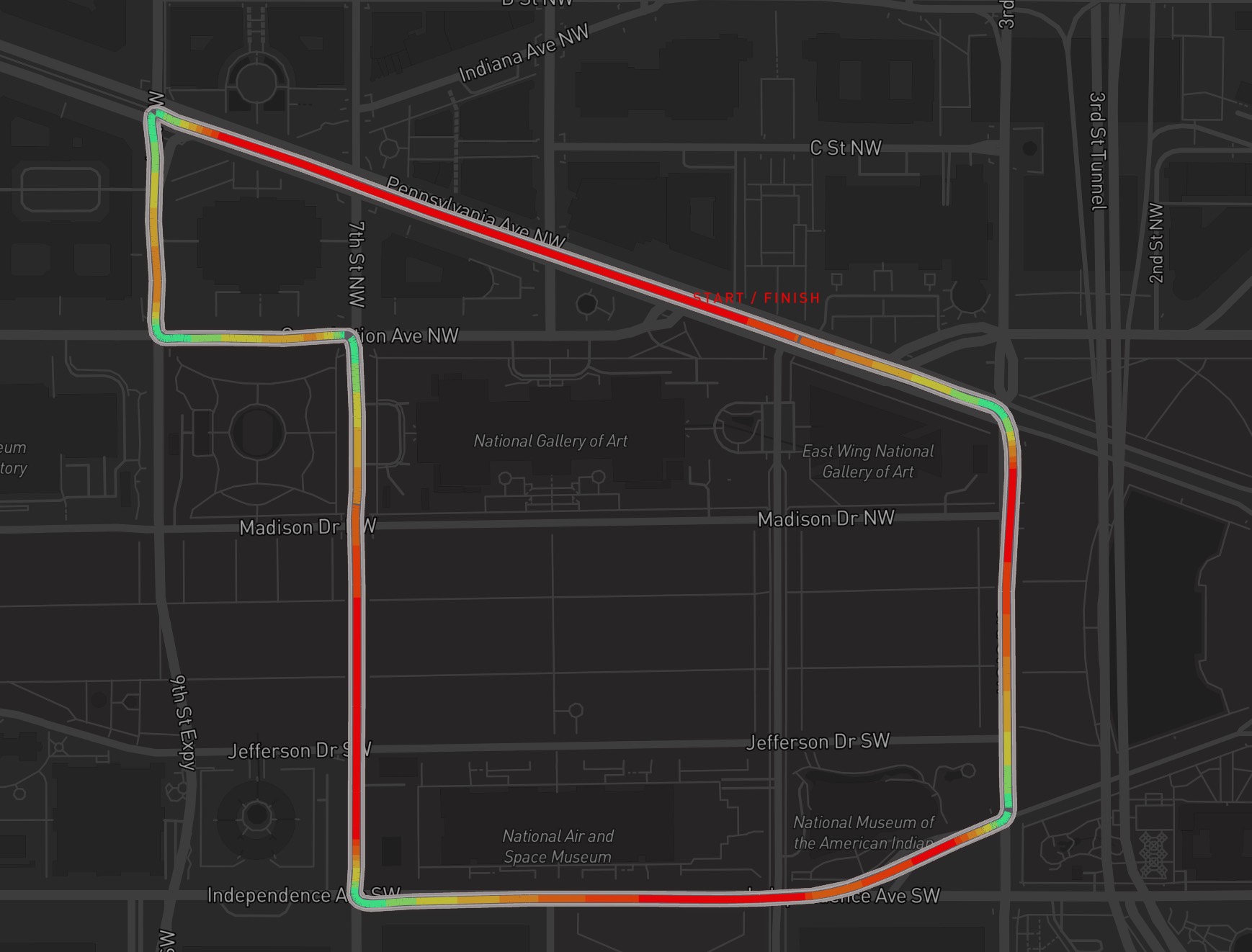
Is a 7-turn track good for racing?
Seven turns is the fewest of any street circuit on the 2026 IndyCar calendar, and it is not close. Set the corner counts against the lengths and the density tells the story: St. Petersburg packs 14 turns into 1.8 miles, Long Beach 11 into 1.968, Markham 12 into 2.19, Detroit 9 into 1.645. That is between 5.5 and 7.8 turns per mile. Washington runs about 4.1 turns per mile.
The consequence is arithmetic. Add up the straight sections of the lap — 740 metres on Pennsylvania Avenue, 500 down 7th Street, 600 through the Independence and Maryland run, 345 up 3rd Street — and more than four-fifths of the circuit is straight line. Everything that makes a lap interesting is compressed into a handful of short, hard events.
Whether that is good depends on what you want from a street race, and there is a real case on each side.
The case for good racing starts with the oldest rule in overtaking zone design: a long straight into a slow corner is the most reliable passing recipe there is. The Freedom 250 has a textbook one. Over 700 metres of acceleration into a 110-degree left gives a following car time to use the tow, deploy push-to-pass and commit to a move, and the deceleration from 180 mph opens a braking zone wide enough to run two cars side by side. Turn 5 offers a second, shorter version of the same thing. Two genuine passing zones is more than several circuits on the calendar can honestly claim — Monaco, the most famous street circuit in the world, has arguably none, as we found when we rebuilt it from scratch. Low corner count also means low aerodynamic dependence: cars will run less downforce, which reduces the dirty-air penalty that makes following so hard elsewhere. And a 54-second lap means traffic. With 125 laps to run, backmarkers arrive constantly, and lapped traffic through the tight 9th Street corner complex is where leads are won and lost.
The case against is equally concrete. Street circuits have walls where run-off should be, and a wall is a strong argument against optimism in a braking zone; drivers who would try a move at Road America will think twice arriving at Turn 2 with concrete on both sides. Single-car, single-lap qualifying — the format IndyCar uses for its street rounds, including this one — puts a premium on grid position, and on a circuit with only two passing zones, track position is close to decisive. Seven turns also means seven chances to make an error rather than fourteen, which reduces the natural churn that generates position changes. And the section between Turn 5 and the line is close to flat out, so the last third of the lap offers little for a chasing driver to work with.
There is a third factor that is genuinely unknown: grip. Sections of the course have been freshly resurfaced to IndyCar standards, and new asphalt on a street circuit tends to be slippery and green early in the weekend before rubbering in fast. Combine that with an almost entirely left-handed layout — one right-hander in seven — and tyre wear will be lopsided in a way teams have limited data to model. Strategy divergence is often where street races find their drama.
The honest verdict is that this is not a technical circuit and was never trying to be. It is a fast, simple, brutally exposed layout built around one enormous straight and one heavy braking zone, in the most photogenic setting American motorsport has ever been handed. Whether that produces a classic or a procession depends less on the drawing than on strategy, cautions and how many drivers find the wall on Saturday.
Drive it yourself
The fastest way to have an opinion about a circuit is to change it. We have traced the Freedom 250 layout into the designer with IndyCar selected as the race type, so the analysis returns realistic numbers for length, longest straight, top speed and estimated lap time:
Open the Freedom 250 circuit in RaceTrackDesigner →
A few experiments worth running once it loads. Push the straight further. Drag Turn 2 west from 9th Street toward 10th and watch the top speed and lap time move — then ask whether the extra speed is worth the shorter, more compromised complex that follows. Add the missing corner. The Independence Avenue to Maryland Avenue run is nearly flat; insert a genuine corner there and the lap gains a third braking zone. Does it improve the circuit or just slow it down? Fix the asymmetry. Try reversing the direction of travel so the lap runs mostly right-handed, and compare the estimated lap time. Change the cars. Switch the race type from IndyCar to F1, GT3 or NASCAR and see how differently each category reads the same piece of road. And if you want to check the tight bits properly, the segment width tool lets you set each section independently — useful here, because the 9th Street complex is where the real constraint lives, for reasons we covered in how wide is a race track.
Then draw your own. The National Mall is not short of alternative routes, and the constraints that shaped this one — existing streets, monument sightlines, where you can physically put a pit lane — are exactly the constraints that make street circuit design interesting. Start from race track design principles, or read how the discipline handles a from-scratch project in our piece on the Madring in Madrid. If Washington is only the beginning of American street racing — and on the evidence of the 2026 calendar, it is not — there will be plenty more layouts to argue about.
Freedom 250 Grand Prix track: FAQ
How long is the Freedom 250 Grand Prix track?
The circuit is 1.7 miles (about 2.7 km). Some earlier releases listed it as 1.66 miles, a difference that comes down to where the measured centreline sits through the corners. The race runs to 125 laps, roughly 212 miles.
How many turns does the Freedom 250 Grand Prix circuit have?
Seven — the fewest of any street circuit on the 2026 NTT IndyCar Series calendar, at roughly 4.1 turns per mile against 5.5 at Detroit and 7.8 at St. Petersburg. Trace the published route and six of the seven are left-handers; only the entry to 7th Street turns right.
What streets does the Freedom 250 Grand Prix use?
The circuit loops the National Mall using 3rd Street NW, Pennsylvania Avenue NW, 9th Street NW, Constitution Avenue NW, 7th Street, Independence Avenue SW and Maryland Avenue SW. The start-finish line sits on 3rd Street in front of the U.S. Capitol, and pit lane runs along Pennsylvania Avenue between Turns 1 and 2.
Why is it called the Freedom 250?
The 250 refers to the 250th anniversary of American independence, not the race distance. The race itself is 125 laps of a 1.7-mile circuit, about 212 miles.
Will there be overtaking at the Freedom 250 Grand Prix?
The layout gives drivers one obvious passing zone — the end of the 0.4-mile Pennsylvania Avenue straight into the Turn 2 braking area — plus a secondary opportunity into Turn 5 at the end of 7th Street. Long straights into slow corners are the classic overtaking recipe, but street-circuit escape roads and a single-lap qualifying format that rewards track position both work against it.
When is the Freedom 250 Grand Prix?
Race weekend is 22–23 August 2026, with the NTT IndyCar Series race on Sunday 23 August and an IROC support race on the Saturday. General admission is free.